The plain-English version
Think of an AI coding setup as a small team. One person can draft a rough version quickly. Another person can review it carefully. A third person can decide whether the work fits the larger plan.
AI models can be used the same way. A local model runs on your own computer or server. It can write first drafts, make small edits, generate tests, and try boring refactors without sending every prompt to a paid cloud API. A frontier model, such as a top-tier hosted model, can then review the important pieces: architecture, security, edge cases, and whether the code actually solves the right problem.
This is the engineering graph we like: use cheaper local work for volume, then spend premium tokens where judgment matters.
What is a local AI agent?
A local model is an AI model that runs on hardware you control, usually through a tool like Ollama, LM Studio, or a local development server. It does not need to be the smartest model in the world to be useful. It needs to be good enough for bounded tasks.
An agent is a model wrapped in a workflow. Instead of only answering a chat message, it can inspect files, edit code, run tests, and report what happened. That extra tooling is what makes the model useful for engineering work.
For a beginner, the important distinction is simple: the model is the brain, and the agent is the brain with hands.
The graph: who does what
A practical setup looks like this:
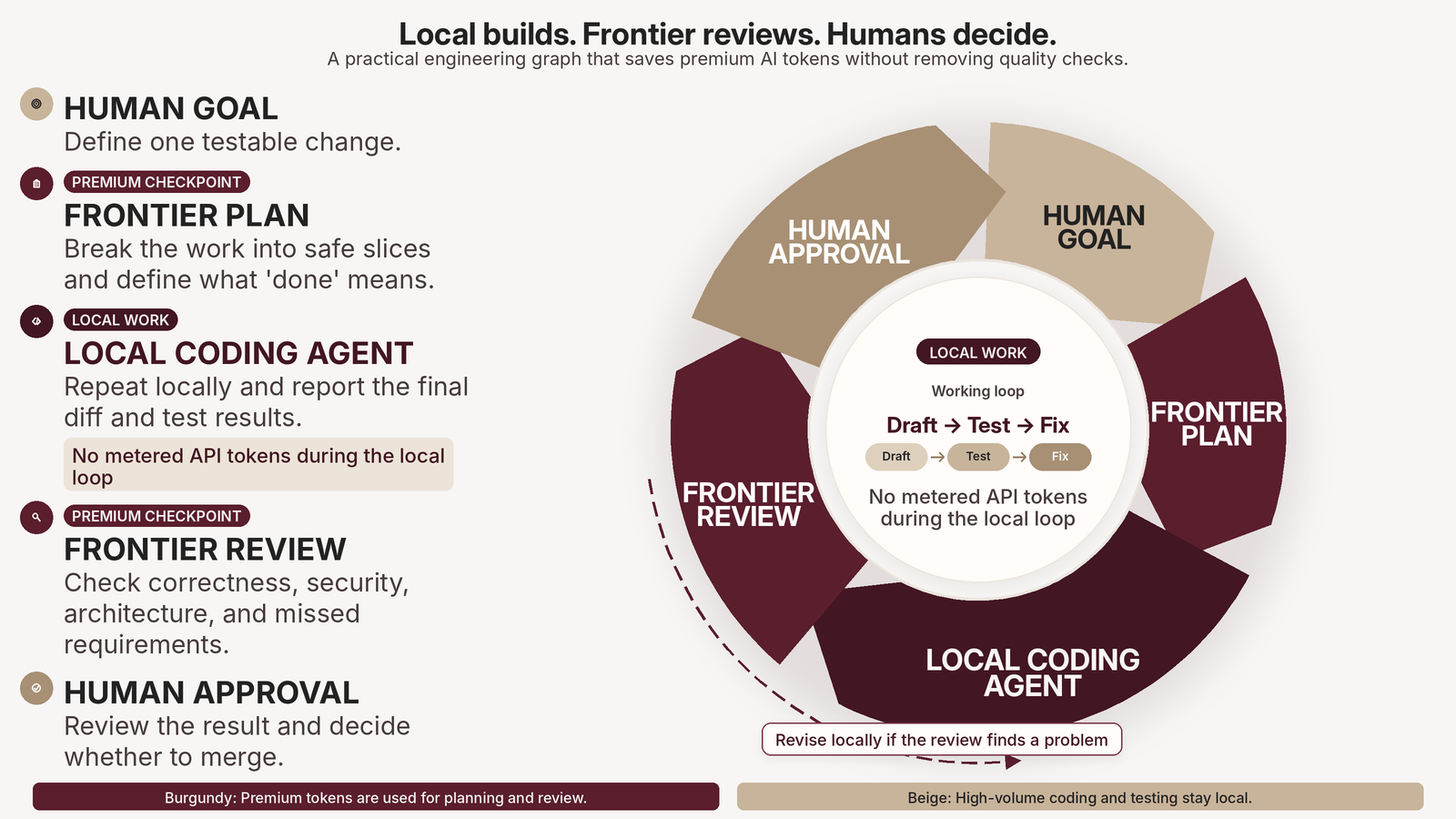
- Human goal: Describe the change in plain language. Keep the task small enough to test.
- Frontier planner: Break the work into safe pieces and define the acceptance criteria.
- Local coding agent: Make the first implementation, add or update tests, and run the checks locally.
- Local self-check: Summarize the files changed, tests run, and anything uncertain.
- Frontier reviewer: Review the diff for correctness, security, maintainability, and missed requirements.
- Human approval: Decide what ships. The human owns the result.
Written as a flow, it is:
Goal → frontier plan → local build → local tests → frontier review → human approval → merge.
Why this reduces token usage
Most coding work creates a lot of tokens. The model reads files. It writes code. It reads errors. It writes a fix. It reads the test output. It tries again. If every loop uses a premium hosted model, cost can climb quickly.
A local agent can handle many of those loops without metered API tokens. It may take more attempts, and its first draft may be rougher, but the cost of trying is much lower. Then the frontier model sees the concentrated version of the work: the plan, the final diff, the test results, and the questions that remain.
That is the main savings. Do not send the entire messy process to the expensive model. Send the parts where its judgment is worth paying for.
Where local models work well
Local agents are a good fit for first-pass work with a clear boundary:
- Small bug fixes with a failing test or obvious reproduction.
- Boilerplate, adapters, scripts, data cleanup, and simple UI wiring.
- Writing tests for code that already has a clear interface.
- Renaming, formatting, documentation updates, and repetitive refactors.
- Explaining a narrow part of a codebase before a human or frontier model reviews it.
Local models are less reliable when the task needs broad architecture judgment, product tradeoffs, security decisions, or a deep understanding of business context. Those are the places to bring in the stronger model and a human reviewer.
What the frontier model should review
The frontier model is the expensive reviewer, not the typist. Give it the information it needs to judge the work:
- The original goal and acceptance criteria.
- The final diff, not every failed attempt.
- The test command and actual test output.
- Known risks, skipped checks, or places the local agent was unsure.
- Any security-sensitive files, data handling, permissions, or external calls touched by the change.
Ask for a review, not a rewrite. A good prompt is: “Check this change for correctness, security issues, missing tests, and mismatches with the stated goal. Do not rewrite unless you find a concrete problem.”
Guardrails that matter
This setup only works if the graph has brakes. Use these rules before trusting it with real code:
- Keep tasks small. One bug, one component, one workflow, or one testable slice.
- Require tests. The local agent should run the relevant checks and report the exact command and result.
- Review diffs, not vibes. The frontier model and human reviewer should inspect what changed.
- Protect secrets. Do not paste API keys, customer data, or private credentials into hosted models.
- Separate building from approving. The model that writes the code should not be the final authority on whether it is good.
- Stop on uncertainty. If the local agent says it guessed, could not run tests, or changed more than expected, escalate the review.
A starter setup for small teams
You do not need a complicated platform to try this. Start with one repository and one repeatable type of task.
- Install a local model runner on a development machine.
- Choose a coding agent that can edit files and run tests in a sandboxed branch.
- Write a short task template: goal, files likely involved, acceptance criteria, commands to run, and what not to touch.
- Let the local agent attempt the first pass.
- Have it produce a short handoff: changed files, test output, risks, and open questions.
- Send that handoff and the diff to a frontier model for review.
- Have a human make the final merge decision.
Measure the result for a week. Track premium token spend, time to first draft, review findings, and how often the local agent needed rescue. If the local model creates more cleanup than value, narrow the task type until the pattern works.
What this looks like in practice
A small team might ask a frontier model to design a safe plan for adding a contact-form spam check. The plan says which files can change, what behavior should stay the same, and which tests prove the change works.
The local agent then edits the form handler, adds a test, runs the test command, and reports that the checks passed. The frontier model reviews the diff and notices that the error message could leak too much detail to a spammer. The local agent makes that small correction. A human reviews the final diff and merges it.
The premium model did not spend tokens on every typo, failed command, or first draft. It spent tokens on planning and catching the issue that mattered.
The practical takeaway
Use local agents for bounded first-pass work. Use frontier models for planning, review, security checks, and final verification. Keep humans in the approval loop.
That combination gives small teams a useful middle path: lower token costs without pretending the cheapest model should make the hardest decisions.